
Temple of Quetzalcóatl (The Feathered Serpent Pyramid)
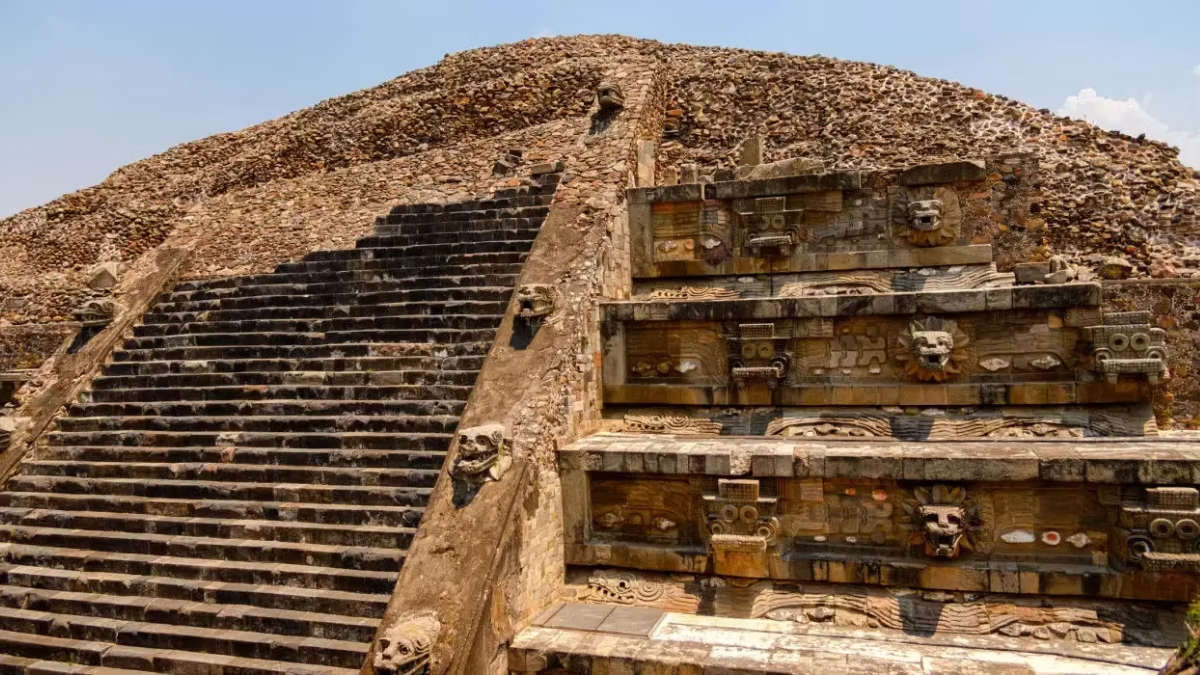
The Temple of Quetzalcóatl — also known as the Feathered Serpent Pyramid — sits inside the Ciudadela compound at the southern end of the Avenue of the Dead. It is the most ornately decorated structure at Teotihuacan, covered in carved heads alternating between the feathered serpent deity and the rain god Tlaloc. Beneath the pyramid, excavations since 2003 have revealed a 103-metre tunnel leading to a large underground chamber with extraordinary ritual deposits. Entry is included in the standard site ticket (MXN 90).
The Temple of Quetzalcóatl is the structure that rewards the most careful attention at Teotihuacan. The Pyramid of the Sun commands through scale. The Pyramid of the Moon commands through position. The Temple of Quetzalcóatl commands through detail — every surface of its visible facade is covered in sculptural carving of extraordinary complexity and quality, and beneath it lies one of the most significant archaeological discoveries made anywhere in the world in the past quarter century.
Many visitors spend too little time here, treating the Ciudadela as a warm-up before the main pyramids to the north. Those who linger — who stand close to the carved facade and look carefully at the serpent heads, the undulating feathered bodies, and the repeated geometric patterns — come away with the most vivid and detailed memory of any single structure at the site.
Key Facts
| Feature | Detail |
|---|---|
| Official name | Temple of the Feathered Serpent (Templo de la Serpiente Emplumada) |
| Location | Inside the Ciudadela compound, southern end of the Avenue of the Dead |
| Height | Approximately 20 metres |
| Construction period | Approx. 150–200 AD |
| Distinctive feature | Alternating feathered serpent and rain deity carved heads on the facade |
| Tunnel discovery | 2003; 103 metres long, leading to underground chambers |
| UNESCO status | Part of the Teotihuacan World Heritage Site (1987) |
The Ciudadela
The Ciudadela (Spanish for “citadel”) is a large enclosed compound at the southern end of the Avenue of the Dead, covering approximately 160,000 square metres. It is bounded by four platforms on each side and contains the Temple of Quetzalcóatl at its centre. The name Ciudadela was given by Spanish conquistadors who saw the compound’s enclosing walls and interpreted them as a fortress. Like the Avenue of the Dead’s name, this is a misidentification — the compound was almost certainly a ceremonial and possibly administrative centre, not a military fortification.
The Ciudadela is one of the largest architectural complexes in the ancient Americas. The enclosing platforms alone would have required an extraordinary mobilisation of labour. At the compound’s interior centre stands the Temple of Quetzalcóatl — visually modest in scale compared to the main pyramids, but architecturally the most complex and iconographically the richest structure at the site.
The open plaza inside the Ciudadela could have accommodated the entire population of the city simultaneously — an estimated 100,000 or more people. This spatial capacity was almost certainly intentional and suggests that the Ciudadela was a venue for the large-scale public ceremonies that were central to Teotihuacan’s political and religious life.
The Feathered Serpent Facade
The most striking feature of the Temple of Quetzalcóatl is its sculptural facade — specifically the talud-tablero construction that presents, on each of its stepped terraces, alternating carved heads of two distinct deity types.
The feathered serpent heads: Large stone heads projecting from the tablero panels, each framed by an elaborate collar of feathers. The serpent’s fanged mouth is open, the eyes are prominent, and the headdress of feathers radiates outward from the head. These are among the most finely carved sculptural works anywhere in pre-Columbian Mesoamerica.
The rain deity heads: Alternating with the serpent heads are squarish heads with large goggle-like eyes, typically identified as Tlaloc — the rain god — or as the Storm Deity, one of the principal deities of Teotihuacan’s religious system. The alternation between the two head types is regular and rhythmic, creating a visual pattern that runs across the full facade.
The undulating serpent bodies: Between the carved heads, the stone surface is covered with undulating serpent bodies in relief — their scales, rattles, and feathers rendered in detailed carving that extends across the full width of each terrace.
How many carved heads? The facade originally contained approximately 365 serpent heads — a number that many researchers interpret as encoding the solar calendar. The current visible facade retains the best-preserved examples; others were damaged or removed in antiquity.
Original colour: The facade was originally painted in vivid colours — red, green, yellow, and black. Traces of paint have been found on the most protected carved surfaces. The unpainted grey stone visible today gives a false impression of the structure’s original appearance, which would have been brilliantly coloured.
The Adosada — The Later Addition
Like the Pyramid of the Moon, the Temple of Quetzalcóatl has an adosada — a later platform constructed against its front face that partially obscures the original sculptural facade. The best-preserved and most visible carved heads are on the sections of the original temple that are not obscured by the adosada.
The adosada was added approximately 100–150 years after the original temple construction, and archaeologists have proposed several explanations: a political change that required the ritual “burial” of the original facade, a reorientation of the temple’s primary ceremonial axis, or simply the continuation of the Teotihuacan practice of encasing older structures in new construction.
The partially obscured sections of the original facade that are visible from the sides of the adosada are among the best places to appreciate the full depth and detail of the original carvings.
The Tunnel Beneath the Temple
In 2003, INAH researchers discovered a tunnel beneath the Temple of Quetzalcóatl by mapping subsidence in the Ciudadela plaza. The tunnel runs 103 metres from an entrance beneath the adosada’s central staircase to a series of underground chambers at its end. Excavations, led by archaeologist Sergio Gómez Chávez, found extraordinary ritual deposits including thousands of spheres coated in a jarosite mineral that gives them a golden appearance, jade figures, obsidian objects, shells, animal remains, rubber balls, and what appear to be the remains of wooden structures. The tunnel is believed to represent a symbolic underworld connected to the political and religious authority of Teotihuacan’s rulers.
The tunnel discovery fundamentally changed scholarly understanding of the Temple of Quetzalcóatl. Before 2003, the temple was primarily understood through its surface architecture and the sacrificial burials discovered in its construction fill in the 1980s. The tunnel revealed an entirely different dimension of the structure — a deliberately constructed underground landscape that appears to have been used for rituals connecting the political authority of the city’s rulers to the cosmological underworld.
The golden spheres found in the tunnel are particularly extraordinary. Hundreds of them were found arranged in specific spatial patterns, coated in jarosite to produce their metallic appearance. Their function is not fully understood — they may represent seeds, stars, or some other cosmological symbol — but their deliberate production and careful placement indicates a high level of ritual intentionality.
The tunnel is not open to visitors but remains under active excavation. The discoveries made within it are detailed in the excellent site museum near Gate 5. For more on what lies beneath Teotihuacan’s structures, see our what's inside the Teotihuacan Pyramids guide.
The Sacrificial Burials
Archaeological work at the Temple of Quetzalcóatl in the 1980s uncovered evidence of large-scale human sacrifice associated with the temple’s construction. More than 200 human burials were found in the construction fill and surrounding areas — individuals interred with offerings including obsidian points, shell ornaments, and pyrite mirrors.
The burial arrangement suggests these were sacrificial victims rather than honoured dead — many were found with their hands bound behind their backs. The number and arrangement of burials across multiple deposits is consistent with a series of dedication ceremonies conducted as the temple was constructed, with victims offered at each major construction phase.
These discoveries, combined with similar evidence at the Pyramid of the Moon, established that sacrificial ritual was central to Teotihuacan’s construction programme in a way that had not previously been fully understood.
How to Visit
The Temple of Quetzalcóatl is accessed through the Ciudadela compound, which is entered from the Avenue of the Dead via the compound’s eastern entrance. The walk from the temple’s facade to the Avenue is approximately 5 minutes.
Most logical route: Enter the site through Gate 1, walk directly into the Ciudadela, spend 30–45 minutes at the temple and compound, then walk north along the Avenue of the Dead to the Pyramid of the Sun and Pyramid of the Moon.
Allow adequate time. The Ciudadela and temple deserve at least 30–45 minutes — more if you are examining the carvings in detail. Most rush-through tours spend 10–15 minutes here, which is insufficient. The carved facade rewards slow, close examination.
Stand close to the facade. The scale and detail of the serpent and deity heads is best appreciated from 2–3 metres away, not from the far side of the plaza. Walk to the barrier and look directly at the carvings at eye level — the depth of the carving and the quality of the stonework become fully apparent only at close range.
For a full site map showing the Ciudadela’s location relative to the other structures, see our Teotihuacan Pyramids map guide.
Frequently Asked Questions
What does Quetzalcóatl mean?
Quetzalcóatl means “feathered serpent” in Nahuatl — the language of the Aztecs. Quetzal refers to the quetzal bird (prized for its iridescent green feathers), and cóatl means serpent. The deity Quetzalcóatl was one of the most important in the Mesoamerican pantheon and appears across multiple cultures and time periods. Whether the specific deity depicted at Teotihuacan’s temple is the same Quetzalcóatl worshipped by later cultures is debated by archaeologists.
Who built the Temple of Quetzalcóatl?
The same unknown civilisation that built the pyramids — the ancient Teotihuacanos, whose language and identity remain unknown. The temple was constructed around 150–200 AD, during Teotihuacan’s period of rapid expansion. Its builders and the rulers who commissioned it are anonymous to history.
Is the Temple of Quetzalcóatl the same as the Pyramid of the Feathered Serpent?
Yes — these are different names for the same structure. It is also sometimes called the Templo de la Serpiente Emplumada (Temple of the Feathered Serpent) in Spanish. All refer to the same pyramid inside the Ciudadela compound.
Can you climb the Temple of Quetzalcóatl?
Partial climbing is permitted — visitors can ascend the adosada platform to a certain level. The summit of the original pyramid behind the adosada is not accessible. Check the current access situation on arrival.
How long should I spend at the Temple of Quetzalcóatl?
At minimum, 30 minutes to walk through the Ciudadela and examine the temple facade properly. Forty-five minutes is better — enough to walk the compound perimeter, examine the carvings from multiple angles, and read the information panels. Rushing through in 10–15 minutes, as many group tours do, means missing the detail that makes this the most artistically significant structure at the site.
What is the difference between the Temple of Quetzalcóatl and the other pyramids?
The Sun and Moon pyramids are larger and more dramatic in scale but relatively plain in decoration — their power comes from mass and height. The Temple of Quetzalcóatl is smaller but far more elaborately decorated — its facade is covered in detailed sculptural carving that tells a more complex iconographic story. It is the site’s most artistically rich structure and the one that reveals the most about Teotihuacan’s religious and political ideology.
